Thaddé Comar_ How Was Your Dream?
4th June 2026
30th June 2026
The Swiss Cultural Fund UK is proud to support the exhibition How Was Your Dream? by Thaddé Comar at Belfast Photo Festival, alongside an exhibition by Sabine Hess and Nicolas Polli (One Bed, Two Blankets, Eighty-Five Rules).
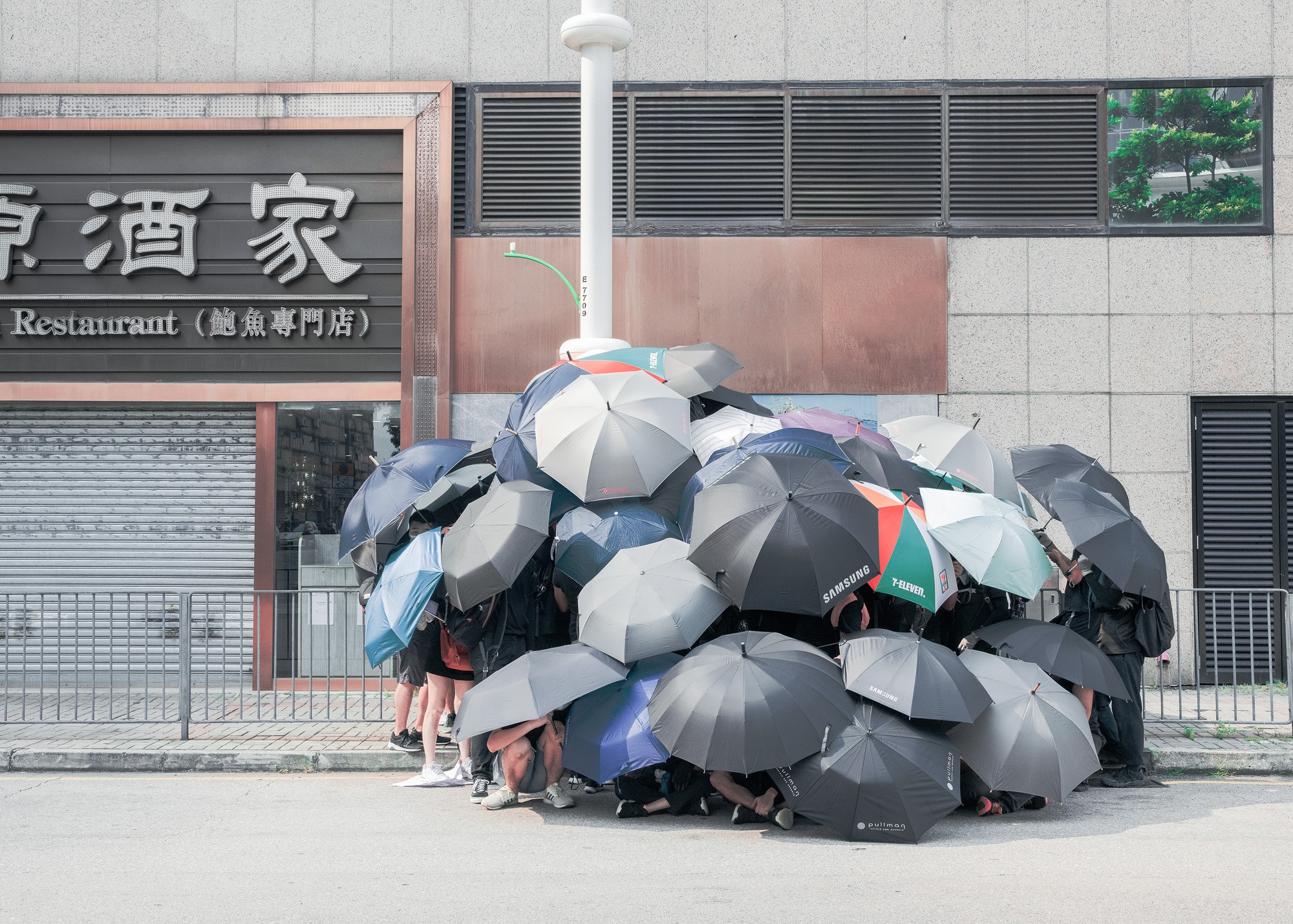
Thaddé Comar's photographic work highlights how the surveillance technologies used by law‑enforcement forces during the Hong Kong protests in 2019 contributed to transforming the forms of struggle and resistance adopted by demonstrators, while also leading to the gradual erasure of individual singularities. He kindly answered to the SCF a few questions ahead of the festival.
Swiss Cultural Fund UK: How did How Was Your Dream? come about?
Thaddé Comar: In 2017, I started documenting protests in France under François Hollande. I focused on the Black Blocs, a group of protesters from different political backgrounds, using black clothing and anonymity to confront police violence and create a form of response to repression. They also aimed to take the lead in protests and challenge the dominance of old, entrenched unions.
A few years after documenting these tactics and the different actors within these codified events, I came across news and videos about the Hong Kong movement in 2019. I knew these people were facing a different level of surveillance, but they seemed very creative in developing tactics to avoid it.
I felt it was a continuation of my work, and naturally, with the support of the Swiss Arts Council Pro Helvetia, I decided to go there and start a project.
Could you please tell us about the title?
The word “Dream” has been widely used on different messaging platforms by Hongkongers as a substitute for the word “protest.” It’s a way for protesters to avoid incriminating themselves.
Coming back to France with all the material I created, this idea of a dream felt like a strong angle to approach the images. It carries multiple meanings and political references. In the same way as a protest, dreams are a personal experience that always involve individual senses and points of view.
So the question became the backbone of the work, and especially of the book’s structure. It’s a way for me to acknowledge that these images are a personal proposition – an expression of a subjective point of view and experience. It also introduces a kind of science fiction perception of reality, creating a space where images can behave or be presented more freely.
Your work often deals with the tension between anonymity and exposure within protest movements. How do you navigate this tension and position yourself as a photographer and outsider?
Anonymity is becoming more and more necessary for protesters to remain safe. So my position as a photographer begins with the idea that my images should not endanger the people physically involved in these movements.
At the same time, anonymity creates an interesting contradiction: protesters need to be seen so that their movement and demands can be heard, yet they must hide themselves to avoid being prosecuted or profiled by the government.
In that sense, the act of protesting while remaining anonymous is directly linked to the presence of the camera. I believe this opens up an important line of reflection for an artist working with photography.
What role do artists play today in the “war of images” you describe?
I think we have to propose different narratives and rhythms – both in the way we present images and in how we consume them, but also in relation to the pace imposed by today’s world. At the same time, the “war of images” is something that happens daily, involving media, influence, and power. And I sometimes feel quite far from having a real impact through photography today.
How do you feel about the project traveling and about it being presented at the Belfast Photo Festival?
This work has already traveled quite a bit — it has been shown in Spain, Germany, Greece, and other places. Belfast is a very particular place to present this project, as it is deeply marked by a strong historical context linked to social movements and radical action.
I’m not yet very familiar with this history, but I’m really glad to have the opportunity to learn more about it, and hopefully to present work that can resonate and raise questions in this specific context. So it’s really a pleasure and a great opportunity to be part of the festival.
Thaddé Comar, How Was Your Dream?, Belfast Photo Festival, 4 – 30 June 2026. More info
Image Credit: Thaddé Comar